


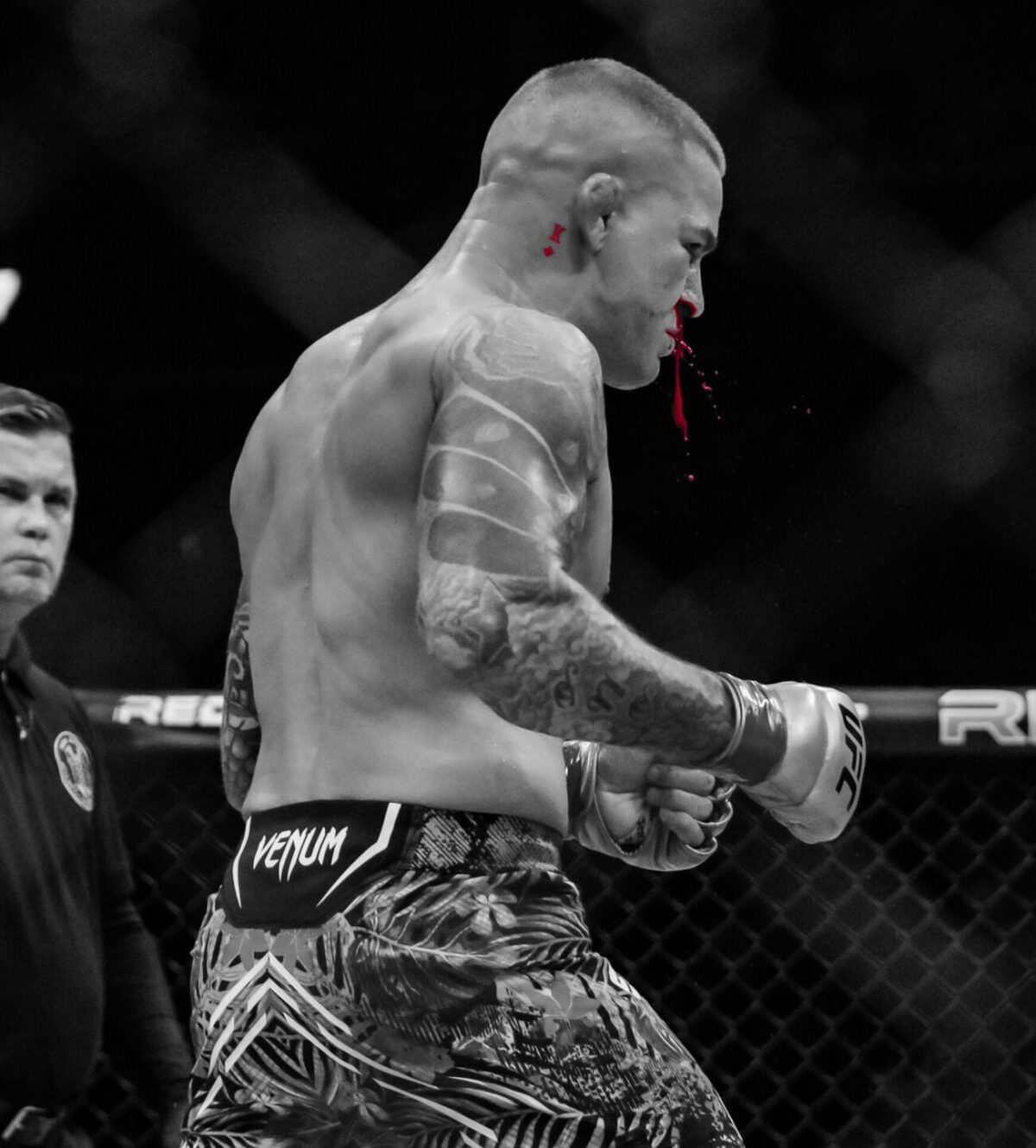
Dustin Poirier. The Diamond. One of the only fighters who although he never won an undisputed title, is not usually seen as any less of a champion. A true fighter’s fighter, who had he been born in a different era, likely would have reached the summit. He has been an inspiration to so many through his resilience, clawing his way to the top despite setbacks. We see the theater of his life personified every time he steps into the octagon.
Here, I will be performing a complete, holistic review on Poirier’s fighting style throughout his entire career, from similarities, differences, and adjustments. The audience truly saw a young man grow up before their eyes, and it’s a treat for me to cover it. This piece will be objective analysis, yet legends like Poirier, Oliveira, etc. deserve more than that. They better get the credit they all deserve, because fairy tale endings are typically reserved for Disney, not MMA. Yet, I hope Dustin can find a way to author one. Without further ado: a step by step breakdown on the King of Diamonds.
Dustin began his career as a highly entertaining brawler, like a bar fight final boss. It was obvious that he was a talented martial artist, but he was far too reckless for his own good. His proclivity to hunt the finish at all costs and swing for the bleachers made him must-see television, but his lackluster defense prevented him from reaching the upper echelon.
Poirier, in the beginning, did not have much to write home about in terms of his striking, although his grappling was noteworthy, with him being known for his D’Arce choke during this time period. Poirier exhibited several key errors in his striking, which for a fighter who would come to be known for his boxing, would need to be corrected. Now, Dustin did have a few similarities then to who he is now. His right hook remained a dangerous weapon, and he threw low kicks nicely. Yet, he would overextend his punches, keeping his chin in the air with his head far in front of his hips. His feet would often come out of alignment as well, instead of a balanced, staggered stance. He also did not measure reads or distance all that impressively, as shown when he would advance, running forward with seemingly little care for strategy. By contrast, modern Dustin is much more aware of his stance, when to switch, when to stay measured, etc. Early Poirier seemed to have a Derrick Lewis attitude, that being “throw some bullsh*t and see if it lands”.
We see Poirier’s wild man mentality early on, such as his first fight with Holloway in 2012, with messy pocket exchanges, overextension, and chin left hanging in the air. Against Jonathan Brookins shortly after, he again shows rookie mistakes, throwing a sloppy overhand left, which causes him to be noticeably off balance. This demonstrates that he was having difficulty managing his distance and technique. Against Diego Brandao in 2013, a perfect instance of what I am talking about is shown. Early on in the round, Poirier throws a looping left hand, then an upwards right hook, which is thrown with a straight arm like a baseball bat. Just from reading that sentence you can probably tell that his whole body is all over the place. This hyperextension was a key reason for Poirier’s losses, and why he had to alter his game. Against McGregor in 2014, Conor was not in his “lifting weights” era. He was a sharpshooter, and he took advantage of Poirier’s high chin and long swings to counter him with a left straight multiple times. Here, Poirier had a pretty underwhelming defensive game, simply covering up in a high guard with his forearms in front of his face. All Conor had to do was convert from a left straight to a left hook in order to loop around Poirier’s guard. Eventually, this left Poirier on the canvas. Against the best in the world, it was clear that Poirier needed to adapt.
Vital to note at this juncture was Poirier’s use of shifting strikes. When reading a piece on Poirier by analyst Jack Slack (at least what he goes by on social media), I realized how important the shift truly was to Poirier’s game, even in modern times. Poirier utilized shifting blows differently than how they are typically incorporated in boxing. Part of it is his fighting style, and another part is the fact that MMA bouts take place at a significantly farther distance due to the use of kicks and takedown threats. As Slack states, this can lead to fighters simply backing away due to the extra space, rather than working on their striking defense (such is certainly the case with early Poirier). This shift was a way for Poirier to cover distance and land damage. However, he performed it in an undisciplined way, and overused it.
Firstly, Poirier, as a southpaw, would throw a left straight to cause his opponent to retreat. They would usually back up and reset rather than risk getting struck. Then comes the shift. After throwing the left straight, Poirier steps forward into an orthodox stance. As he steps through, his head is far ahead of his hips and he leads with his head as he lurches forward. Assuming the opponent retreats from the left straight, Poirier almost always follows up with an overhand right or right hook after he shifts. So, the purpose of the left straight is not to land (although if it does, that’s great), but rather to line the opponent up for the right hand. The shift is therefore a way for Poirier to cover distance quickly (without having to shuffle forward in southpaw) and shoehorn his opponent into his right hand. As the opponent retreats from the left, he can catch them leaning back with the right. If the other fighter does NOT retreat from the left straight, he has another option. Poirier can simply crash into them with his left shoulder/forearm as he shifts to orthodox, throwing them back himself, thereby funneling them into the right hand.
Below, against Brandao, Poirier executes the shift. He throws the left straight from southpaw, then as Brandao ducks, Poirier uses his left forearm to push him back so he can line up the right hook.
The shift works, but to a point. It is possible to have too much of a good thing. The shift worked for him well because it allowed him to mitigate the lengthy range MMA takes place in. Poirier got addicted to this. It was only when he started to face skillful strikers that it became obvious that Poirier was a bit of a one trick pony. If he performs the shift constantly, it becomes picked up on. Since he extends his face so face forward and throws his whole body into the shift, he is little more than a sitting duck for a technical striker. In particular, the shift is dangerous because Poirier must switch stances. As a southpaw, he sacrifices the protection of his lead right shoulder, and makes things worse by presenting his face so far ahead of his hips. To switch stances, his feet must pass each other or at least become somewhat level. In this moment where he switches, he is in poor balance should he receive a blow. In this way, the shift is high risk but high reward, at least the way Poirier used to use it. Later, he found ways to use it as a tool, not a crutch, but that’s for later in this piece.
It was against Michael Johnson in 2016 that Poirier was finally forced to face his demons. Johnson pretty clearly had superior boxing and footwork. By comparison, Poirier was crossing/aligning his feet, and failing to tuck his chin as he threw offense. Johnson picked him apart with sharp counters. As Dustin charged in with a jab to left straight combination, Johnson pivoted and threw a counter right hook that put Poirier down, taking advantage of the high chin. After this knockout loss, Dustin stated that he would prioritize being more defensively responsible, and that he could no longer allow his skillset to atrophy. Some lessons can only be learned the hard way, and learn he did. Against Jim Miller, he proved that he wasn’t just talking, he was evolving.
I love the Miller fight against Poirier. Here was where he started to look like the Dustin Poirier we know. Now, I am not saying he was a final product off the assembly line, but he certainly looked the part of a changed man. Poirier was not perfect here, but there was marked change in his head movement, with his new attitude towards defense taken to heart. He started to take his head off the centerline as he threw strikes, making a conscious effort to duck and guard it. He no longer fought like he was just wailing punches on a heavy bag, he fought expecting return fire. Throw offense, defend and move, reset. He appeared far more mature, abstaining from forcing the finish if it was not there right away. As he had Miller hurt and retreating against the cage, he remained defensively sound, picking his shots well, and was cognizant of counters by ducking, rolling, pulling and slipping in between combinations.
Poirier really started to showcase how excellent of a counterstriker he was becoming in this fight, particularly as a boxer. The shoulder roll in boxing is used as a safe way to roll/deflect punches, safely picking off the blows in order to place the user in position for a counterpunch. Poirier’s hillbilly shell (what I have decided to call Poirier’s unique variation of a stonewall defense) was a unique recipe for Poirier to modify boxing defense in the structure of MMA. For a detailed explanation of the hillbilly shell, refer to part one of this series. When backed up against the cage, Poirier actually does some of his best work (i.e. the Chandler bout). His shell(s) allow him to absorb the damage he takes and enable him to time his own punches. Make no mistake, being against the cage is never good. However, any time an opponent was close enough to hit Poirier, they were close enough to hit back, and for a fighter as difficult to hit cleanly as Dustin, chances ran high that the aggressor would get cracked with something.
See below for a beautiful display of the brand new model of Dustin Poirier against Miller. He is nearly unrecognizable from the fighter he was a couple of years prior. Note the beautiful display of versatile striking and defensive maneuvers. We are going to touch on some of these very shortly.
We saw shades of the above defense and counterattacks earlier on in his career, but Poirier started really putting the pieces together here. The Miller fight was our first glimpse at modern Dustin. Now, we can really start dissecting his contemporary game.
Next up on the essentials of Dustin Poirier: the jab, both his own and his opponent’s. Poirier is excellent at the point of attack, just within range. In particular, Dustin can incorporate his own jab and deflect a return shot at the same time. After he throws his jab, if he sees the opponent throw something in return, he can leave his right arm out as a post, then point his right elbow skywards, causing the punch to ricochet or alter its velocity so it no longer lands cleanly. Below, against Justin Gaethje, Poirier jabs, then posts shortly after, pointing that elbow up to deflect a left hook towards the top, harder part of his skull. Poirier used this maneuver in his second bout against Holloway to deflect jabs.
We are not done covering the jab. Poirier’s handfighting is a marvel to behold, and he uses his jab to set traps for his opponents. One trick Poirier loves is faking the jab to draw the opponent’s parry. Once they try to tap away his jab, Poirier switches up the trajectory and converts the jab into a quick right hook, curving around the opponent’s hand. Even if the jab does not draw a noticeable parry, it is still a slick way to vary his arsenal and keep the other fighter guessing. Prime examples of this are during his fights with Miller, Alvarez, and Gaethje. Below, against Eddie Alvarez early on in the second fight, Dustin feints a jab, then converts it to a right hook around the guard. He does this in the second video in the first Gaethje fight, where he draws a parry first.
The point I am making is that Poirier is difficult to line up offense against. His long reach and proficiency with the jab (both offensively and defensively) make it difficult for an opponent to get inside, especially considering his shell defense. Poirier, during and after the Miller fight, began making a good, crisp jab a cornerstone of his game, picking apart the opponent from distance. This was a key part of how he beat apart Alvarez’s face. He did a great job showcasing patience and jab proficiency against Gaethje the first go around as well. As Gaethje shells up, rather than going crazy, he jabs over and over again, then throws power shots once he has his reads right. What is interesting is that Poirier would also use his long left straight as a power jab, sticking the opponent with it whenever they tried to circle and throw a right hand, with prime examples being his fights against Dan Hooker and Alvarez.
Below, Poirier jabs at Gaethje with surgical precision before throwing power strikes
We touched a lot on Poirier’s counters during part one. Throughout his career, though, there are just so many more good ones that I would be irresponsible to leave them out. As I mentioned there, Poirier can counter almost any punch effectively. He shells up, lets the opponent’s blows glance off his shields, then counters once the danger has passed. Poirier’s best weapon is his right hook. So many of his best counters come off of pulls in order to land it. Let’s look at this.
Poirier augmented abilities came with a heightened understanding of his boxing range. He maintained his safety far better, and liked to stay just outside the edge or just within his opponent’s reach. An integral part of boxing is head movement, and at this distance, when his opponent would fire a shot, Poirier could pull back just enough, then whip a counter, very often that check right hook. Classic example: the second McGregor bout, which showed without a doubt the night and day difference between Poirier in 2014 and 2021. Poirier seemed much more aware of Conor’s tactics, and as McGregor threw that left straight he loves, Poirier just pulled/swayed his head back and threw a check right hook over the top. Pulls were also apparent in his title fight against Oliveira. As mentioned in part one, Poirier can counter almost any punch with pivots, turning his head to the side to avoid the sting as he throws a counter hook over his opponent’s arm (see second Holloway & BSD fights).
Below, as Oliveira tries for a right uppercut, Poirier pulls back and drops Charles with a clean right hook.
Poirier’s shell defense is his bread and butter. What is lovely about this is that Dustin does not need to be incredibly athletic or rely on grandiose movements like Rafael Fiziev to avoid damage. Once he is shelled up, he really does not have to move much to block, especially for a fighter who is well versed at timing defense. His shells allow far greater protection than just parrying a four ounce glove with another, like Oliveira likes to do. Poirier fluctuated between his standard hillbilly shell and a modified philly shell. He would alter his usual elbow block at times , dropping his right hand towards his hip and pointing his elbow up and out, like a chicken wing. He would then angle his body sideways and tuck his head behind the right shoulder. Point being: he gets a huge piece of bone pointing outwards as a barrier, with few open targets around it. The Philly shell, meanwhile, allowed him to protect his body better than the hillbilly shell.
Poirier executes the philly shell by hiding his head behind a high shoulder while that same forearm protects his beltline. His other arm is up high around the other side of his head, the forearm and wrist guarding his jaw. Below, Dustin throws up a philly shell against Michael Chandler as he is pressured, then transitions to a higher guard to protect his jaw, finally rolling off Chandler’s right hook to throw a beautiful counter right which drops Chandler.
If Dustin cannot get his hands up or deflect a strike completely, he is not necessarily screwed. He can still find ways to reduce the impact. Against Miller, for instance, Poirier throws a jab, which draws a right hook from Miller. Poirier, without ample time to block, ducks his head into the shot, so it ricochets off the hard top part of his skull (this can be seen in the earlier Miller video). Poirier did something similar against Holloway in 2019, deflecting Max’s jabs upwards off the top of his head.
Against BSD, Poirier was caught a couple times with his hands down. He was unable to block, but what he DID do was pull back and turn his head to the side, once again rolling with the punch and reducing damage.
Think about it. Poirier is so malleable with his stonewall defense and types of shells, and all it takes are small, energy efficient movements to convert from one to the other. And, even when he doesn’t block completely, he often is not wide open. When you consider that one of his best strengths are infighting and dirty boxing, even getting him against the cage is not as secure as it might seem (check out the pistol whip he used on Hooker). He is far from infallible, but you
cannot say he isn’t efficient.
For a couple of interesting examples of Poirier’s use of shells, please refer to part one.
As we talked about in the beginning of this piece, Poirier showed maturity in how he used his shift. No longer did he beat this dead horse to oblivion. Yet, he still consistently included it in his game, using it sparingly to surprise his opponent. He was better able to keep his balance and defend during the transition from southpaw to orthodox, and was heavily aware of its drawbacks.
The below video shows how far Poirier came with his refinements. Versus Conor the second time around, he throws the left straight and begins to shift, subsequently slipping to his right as opposed to just lurching forward. This allows him to slip right under Conor’s counter left, and instead of throwing the typical right hook, Dustin level changes and takes Conor down instead. McGregor seemed stunned by this, a fact that was picked up on by the commentary team.
Aside from his defensive versatility and counterpunching prowess, Poirier, though he is known for his boxing, is not solely a boxer. He will never be Alex Pereira, but he does throw one kick well. The calf kick. A hallmark of American Top Team, Poirier has been successfully throwing calf kicks for years. He has always been skilled at punctuating combinations with them, but there were a couple contrasts between Dustin then and Dustin now. WEC/early UFC Poirier threw low kicks to the outside thigh, which was traditional at the time. More modern Poirier targeted the calf instead, like a sniper. Poirier varied his kicks to greater effect, hitting both the inside and outside. His timing was noticeably improved. In the second McGregor fight, he hobbled Conor badly. Poirier showed his intelligence by waiting for Conor to put weight on that lead leg, then time both inside and outside calf kicks. For example, as Conor goes to jab, he must put weight on that foot. Poirier, waiting for this, punted out the leg as soon as he saw it. In fairness, this has also been done to him, i.e. the Miller and Gaethje fights.
This last facet was picked to culminate this article for a reason, because it was one of the final pieces that were added to his game. Pieces that we really only saw in all their glory during his very last fight before this Holloway trilogy. Defensive wrestling. While Poirier is a jiu jitsu black belt, he traditionally struggles against wrestlers, with his habit of jumping guillotine doing him no favors. Seriously, the guillotine calls to him like the green goblin mask. Yet, he did several things well against the premier grapplers he fought, namely Khabib Nurmagomedov, Oliveira, and Makhachev.
Against Oliveira and Makhachev in particular, Poirier employs a tactic that I have seen best described as “get the f*ck off me”. Oliveira and Islam both love their collar ties, and rather than try to grip fight or level change (or even infight, which he also loves to do), Dustin deals with it in a rare way. When Charles and Islam got a double collar tie on him, Dustin leaned his torso back, thereby lifting the opponent off the ground, picked them up by their armpits, and literally shoved them back and off of him. Brutish, but effective.
See below for this maneuver against Oliveira late in round one.
Makhachev was Poirier’s magnum opus in terms of his grappling development. He stifled and frustrated Islam in a way that had not been seen since Volkanovski. In the best title bout he has ever had, Poirier did a far better job than many expected at keeping takedowns at bay and getting back to his feet. Poirier was able to defend single leg takedowns like Jose Aldo, pushing Islam’s head away, turning to point his knee down, and limping his leg out. He was able to reverse and escape, such as when he evaded a seemingly surefire kimura attempt in round one. Yet, a small detail that stood out to me was Poirier’s switch that he used against both Khabib and Islam. The switch is used to reverse an opponent’s forward pressure by sitting out. Now, I understand that the success of the switch is somewhat attributable to the different fighting styles of Dustin’s opponents, Khabib in particular has greater smothering pressure and control than Islam. I still think this is noteworthy though, because Poirier switched enough to present a pattern. Against Khabib and even Dan Hooker, the switch just leads to him twisting himself into the bottom mount. Against Makhachev, however, he gets it right.
In the below videos, Poirier is in a similar situation with Khabib and Islam. He is posting to maintain balance, with his opponent draped over him. He then sits out, underhooking the left leg as he does so. Against Khabib, he is unable to break the body lock, so Khabib steps into mount. Against Islam, things change a touch. Poirier does a better job pinning Islam’s left arm with his own first, allowing him to better break the body lock instead of doing everything in one fell swoop. THEN he underhooks the leg, and is able to scoot his hips further out, creating space for him to scramble. As stated, much of this is centric on the opponent. Khabib stayed in position because he maintained the body lock during the switch, circled towards the back, and kicked his leg out so Dustin could not underhook it. Still, crafty moves by Poirier.
As we end, I’d like to say a few words about Dustin. Assuming you are an MMA fan, you probably see how much love the guy has been getting. I don’t know if I have ever seen a fighter given so much respect in retirement. You would think Poirier had obtained GOAT status by the emotion he has brought out of the fanbase this week. There is a reason for that. It’s not because he’s the best fighter to ever do it. He is not. It is because for as good of a fighter as he is, he is an even better man. In a sport with so many controversies and fake personas, Poirier is the type of person we should promote. He is our real life Rocky story. An ordinary man chasing a pipe dream. Who although he did not win in the end, won things far more important. A beautiful family. A hall of fame career, with a resume greater than most champions. A difference made in his community through his charity. A man who refused to quit no matter how many times he got knocked down. Never in a boring fight, never part of a forgettable night. That is why he is admired as much as he is. Not from the cage, but by the character.
“We fall, but we get up, because the ground is no place for a champion” – Dustin Poirier.