
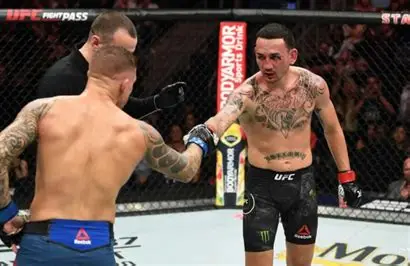
Max Holloway and Dustin Poirier are uniquely intertwined in each of each other’s careers. They each presented a litmus test for each other at the beginning, middle, and now end of their time (in Poirier’s case, at least). Similar to playoff teams, it is common knowledge that they both will be around come crunch time. On more than one occasion, this had led to an unavoidable clash between the two. Holloway and Poirier are not unlike childhood friends, who have seen each other grow and develop over a litany of years. As they grew, so did their skills. As the saying goes, no man ever steps in the same river twice. For it is not the same river, and he is not the same man. Both these men have tread different paths, yet somehow always ended up standing across from each other. They have fought twice already, in 2012 and 2019, and are scheduled to fight again on July 19, 2025. How poetic is it that Holloway’s UFC debut was against Poirier, and Poirier’s retirement fight will now be against Holloway? In this precursor to my breakdown of Poirier’s fighting style through the years, I will be examining both their bouts against each other, and how each fighter is an inseparable part of the other. Let’s look at each of their fights thus far, from similarities, differences, and improvements, as well as what to look out for during their trilogy bout.
A couple key differences between these boys. While both are known for their striking, in particular boxing, they are not clones. Poirier, while not exactly a wrestling wizard, makes grappling a larger part of his game than Holloway, who uses grappling nearly exclusively for defense. They also use their boxing strengths differently. Poirier is far shiftier, a constant moving target with his head off the centerline, blocking, rolling and slipping with beautiful fluidity. Max, by comparison, has a nigh-unlimited gas tank, wearing his opponents down with his pressure and volume punches, possessing the UFC record for significant strikes by a country mile. Unlike Poirier’s constant movement, Max is a bit more locked in place, moving more linearly and emphasizing parries. Holloway likes to back his opposition up and rain combinations. Unlike Poirier, who is known for being one of the most heavy-handed fighters in the entire organization, Holloway relies on accumulation, with his opponents suffering death by a thousand cuts. Poirier is more precise and accurate, with his power and head movement enhancing the quality of his blows. He does not necessarily need to notch hundreds of significant strikes when he possesses true one punch knockout power.
In their first contest in 2012, both were in the infancy of their time in the UFC. Holloway was a mere 20 years old. They were both proficient fighters, but they had not yet refined themselves into a polished final product. I look at them as raw materials at this point. While underdeveloped, there were a few similarities between this first fight and their second, which I will touch on shortly. Both fighters maintain stances that they would favor for the rest of their career, with Poirier predominantly southpaw, and Holloway orthodox. Both also utilize their jabs to obtain reads, sometimes using them as more of a feint to paw and measure distance. They align their lead hands with each other’s in both an offensive (to set up strikes) and defensive (to interrupt their opponent’s attacks) connotation. Holloway, while still needing improvement at this stage, looked quite proficient with his striking, utilizing good timing and parrying Poirier’s jab to counter. Holloways stance was markedly alike to the rest of his career, almost like a praying mantis, with a wide stance and pawing left hand. Holloway, much like his second fight with Poirier, found the most success with straight punches, in particular the 1-2, which he threw constantly. Poirier, for his part, threw with power, but not yet with precision. Big looping hooks and left straights. Poirier’s issue defensively was that when he would swing, he would overextend and leave his chin in the air during combinations, almost like a bar fight. His footwork also left much to be desired, as he would align his feet with each other instead of a balanced, staggered stance. For a fighter who’s bread and butter would be boxing, the footwork would need to be incredibly important. Not to be a cynic, Poirier actually did several things well that he would implement throughout his career. During this first fight with Holloway, for as long as it lasted (inside one round), I like that he ended his combinations with low kicks, creating damage as the two disengaged. This is a pattern that can be seen in his second fight with McGregor, although here he targeted the calf instead of the thigh. This fight also foreshadowed the second in terms of Poirier’s striking defense to guard his head. While not a finished product, this is a definite pattern that was highly developed by their second competition. Poirier, in the mid to late stages of his career, defended head shots with a “hillbilly shell” (I know the term may not be entirely accurate, but it’s funny and I choose to continue to use it). We will get into this in detail when discussing the second fight. In this first fight, he uses somewhat of a similar shell as Max throws a right cross. Poirier slips to the inside and keeps his left arm tight to his head to guard it in a traditional block. He raises his right arm high and bends it, using this as a modified post where he can hide his head behind that shoulder, angling his body behind it. Posts like this can work (see my article on Jose Aldo), but Poirier’s was sloppier and more of a hail mary than anything else. He would modify this later to turn it into more of an elbow block, a version of which is rather unique in MMA. Although I must say, Poirier did exhibit some solid slips and rolled with Max’s punches well on at least one exchange (rolls are a huge part of his modern game). That is not to say Poirier was the only one who made mistakes here. Max attempted a flying knee several times in this fight, without setting it up properly, which led to him being nearly taken down. Poirier would go on to succeed with another takedown shortly after, and ultimately finish the fight with a mounted triangle armbar. Holloway is known for his takedown defense, but not at this juncture. He was a novice in terms of jiu jitsu here. Poirier was much further along with his grappling, and this skill disparity is what won him the fight. Poirier landed a nice double leg takedown and was immediately in side control. From here, he was able to step right over into mount, with Max not even offering a knee shield as resistance. Poirier transitioned between submissions nicely as he went for an armbar, then triangle, then mounted triangle armbar as he rolled to acquire top position. The ground game would be nearly a non factor in their subsequent fight, which we will touch on now.
Much changed during this next competition seven years later, for the interim lightweight strap. Both were now experienced, savvy fighters with their own specific game. Each was among the most talented and technical fighters in their division. Here, Holloway was still the reigning featherweight champion, with Poirier having moved up to lightweight years before, a move which graduated him into the fighter he is today. This fight was neck and neck, despite what the scorecards of 49-46 would have you think. Each round was incredibly close, it was Poirier’s bigger moments that won him the interim championship here. Holloway landed 181 significant strikes, with Poirier landing 178. The power advantage of Poirier was the deciding factor, with the significant strikes being equal. This was not the same Holloway that knocked out Justin Gaethje years later at UFC 300. He did not fill out at lightweight as well in 2019 and has never been known for his punching power, even at featherweight. Volume versus power, skill versus skill.
Just like their first fight, Poirier fought out of the southpaw stance, with Holloway being orthodox (although he does stance switch more often than Poirier). Also like the first bout, they both pawed at each other just outside range, tapping at each other’s lead hand to keep them at bay and time offense. Poirier also punctuated combinations with low kicks, only this time to the calf, whereas in the first bout he targeted the thigh in a traditional low kick. Although he is predominantly a boxer, Poirier commonly throws calf kicks after combinations or on their own, weakening his opponents base, as the calf kick will deaden the leg more quickly. Poirier will never fight like Edson Barboza. You don’t really have to worry about head kicks, oblique kicks, etc. when fighting him. However, he did utilize a few teep and body kicks in this fight appropriately. Holloway pressured more than Poirier in this fight, circling him like a predator stalking its prey. Poirier, for his part, exhibited an offense and defense that was far superior to their first fight. Gone was the exposed chin, and awkward foot position. Poirier set up his offense exceptionally well, and maneuvered defensively in between combinations, a sign of great maturity from the overly aggressive finisher he was at featherweight. Against Holloway, Poirier’s best work came off counterpunching, which was picked up on by the Holloway corner. When he was not countering, Poirier initiated combinations several times by taking a short stutter step with his lead right foot, then taking a much larger one to place his right foot inside Holloway’s lead left foot (at the very least, close to it). The stutter step made it so he did not overextend his stance or telegraph shots from a mile away. He often threw a lead right jab as he did this to blind Holloway and prevent him from seeing what was occurring. Any boxer would be proud at how well Poirier used his jab as a distraction in this fight. After this jab and footwork, Poirier would throw a big left hand behind it. So, stutter step to deceptively cover distance. Then flash a jab while taking a larger step forward to get inside, then a powerful left hand. Poirier’s jab is a great tool, and folks forget that although Holloway is seen as a daddy longlegs, he has a shorter reach than Dustin.
Additionally, Poirier was elite with his head movement. Besides the above jab and stutter step setup, he incorporated his left straight quite a bit. Poirier would punch, slip, then punch again, setting up a further combination if he deemed it appropriate. One of the most noticeable patterns here was when Poirier throws a left straight, he subsequently slips or rolls while he advances (often to the outside right), then follows up with a right hook, his best weapon. We saw this all fight. Dustin also did much the same movement on the other side of things, throwing a right jab then a left hook using this technique. Poirier advances with straight punches, slips/rolls his head, then throws a powerful hook, sometimes on the same side that he throws the straight or jab with. Integrating the head movement allows him to dodge oncoming traffic as he throws his own offense, and slipping to the outside means he can then turn his hips back into his opponent, creating more snap and momentum into the follow up hook. In a fight that was dominated by boxing, details like this are critical.
Below, in figure 1, Poirier is shown throwing a left straight, slipping to his outside right, then turning his hips and capitalizing with a right hook that badly hurts Holloway. Very similar combinations are repeated multiple times.
Both Holloway and Poirier ended up in something of a standoff when at the edge of their respective ranges. As I said, they both pawed their lead jabs out to measure distance and also keep the other at bay. Their power hand became like a lance, trying to strike the other while avoiding the straight punch that was returned to them. They frequently ended up holding each other’s lead hand, sort of like a tug of war to control the other’s posture and hold them in place to line up punches. This grip fighting happened often enough to present a pattern, one that each guy had success with. For instance, Poirier gripped Max’s forearm with his left arm in order to keep him in place to land a short right elbow. Poirier controlled the lead arm more effectively than Holloway, and it enabled him to shut down combinations from his opponent (can’t throw volume when your lead arm is trapped). Look for this tug of war to be present in their third fight, as the lead arm is the first line of defense, and both gentlemen try to avoid or work around it. This grip fighting allowed Poirier to infight rather well. This is a key component of why he was victorious. Dirty boxing and infighting, which allowed him to negate Max’s height advantage and crowd those straight punches that Holloway loves to throw. Poirier utilized short hooks and uppercuts, both with and without a collar tie. Examples of this are when he had Max hurt, and swarmed him with hooks from both directions, or the exact opposite, when he was pressured against the fence and forced to work inside. Poirier is a brawler, and as technical as he has become, making the fight ugly with his dirty boxing is something he can do as well as almost anyone in the UFC.
Poirier’s defense against head strikes is unorthodox, effective, and elite. He rarely gets hit clean, using a variety of different guards based on the offense the opponent is throwing. No guard is invincible, but even when Poirier does get struck, he adeptly rolls with punches, like water off of a duck’s back, allowing him to set up those marvelous counters of his. Poirier’s primary striking shield, in this fight in particular, is the aforementioned “hillbilly shell”. Instead of just throwing up an arm in front of his face like the first scrap with Holloway, he uses a unique elbow block. Let’s break this down into its separate parts. As Holloway advances, Dustin angles the right side of his body towards the danger, leaving less real estate to target for his opponent. He throws up his right elbow and angles it downwards, almost like he is throwing a downward-slicing elbow. His right shoulder is high, and guards both the front and side of his head, which he tucks behind this shoulder. He retreats if possible, with his left hand guarding the other side of his face in a traditional guard. Thus, Poirier makes the target area as small as possible while covering as much as possible. His body is turned to the side, and his head is guarded by flesh and bone, with the right elbow guarding against straight punches, the shoulder protecting against hooks, and the head tucked behind the shoulder as an extra layer of protection. It is therefore extremely difficult to tag him as a moving target, because nothing is open. The only punch that seems to effectively work against this is an uppercut to split the guard, but that requires getting inside without getting countered in open space. Like I mentioned, this guard is not unstoppable, and when Poirier found himself against the fence, he did get tagged. Yet, this guard does a phenomenal job at warding off attacks, particularly when the user is skilled at rolls and head movement to reduce the damage that does land.
See below, in figure 2, and note the high elbow guard towards the beginning of the clip to block Holloway’s punches, then the shoulder roll to have them skid (mostly) harmlessly past him.
One last topic to hammer home regarding Poirier before we can close this chapter in their second bout. Counters. Poirier is a spectacular counterstriker. It is how he was able to stifle Holloway for so long. Holloway could not land punches in bunches or confuse Poirier with stance switches (as he often does) if he was being stung so many times. Now, Poirier nailed various different counters during these 25 minutes. I will cover the most common ones, as analyzing every single combination seems like missing the forest for the trees. Specifically, Poirier timed hooks as he retreated and rolled with Holloway’s punch(es). Whether Max threw a jab, hook, etc., it didn’t matter. Poirier dealt with it much the same. Firstly, Poirier retreats backwards a short distance to avoid the punch, or at the very least pulls his head back. He then plants his feet, turning his body to the side as he whips a hook (typically right) around and over the top of Max’s punch. Rolls played a part here because as Dustin turns, it means Max’s punch no longer lands clean to the intended area. Rather than blocking the strike, Dustin instead turns in the same direction it is going in, that way even if it hits him, it is a glancing blow. As he does this, he is in perfect position to swing that counter hook to Max’s head. Poirier’s head turns too as he does this, once again rolling with the punch. Fighting is a game of inches. Since his head is turned to the side, a punch that would have landed to his chin now glides harmlessly past the side of his head. Retreat if needed, roll/turn with punch, nail that counter hook as you do so. Rinse & repeat.
See the two videos below. In figure 3, as Max throws a 1-2 from the southpaw stance, Poirier times a clean right hook off Holloway’s left straight. In figure 4, as Max throws a left hook, Poirier pulls back and rolls with it in order to time his right hook over the top.
A final tidbit on counters. Poirier, like a snake, waits for openings. Max threw a LOT of jabs and crosses this fight. It was the lion’s share of his significant strikes. Therefore, it made him predictable. There were multiple instances where as Max would jab, Dustin would immediately throw a right hook as SOON as Holloway would begin to retract that arm, landing it to the open target before Holloway could bring his hand back to guard it. Dustin knew the jabs were coming with frequency, so he could time his counters perfectly. Dustin’s ability to counter kept Holloway in limbo. When Holloway cannot lead the dance and pick apart his opponent, he is beatable. Every time he tried to pick up speed, he would run into a brick wall in the form of a Poirier counterpunch.
In figure 5, during the below pocket exchange, Dustin times a gorgeous right hook as Max is retracting his arm back from a left jab.
Poirier often utilizes his elbow block to buy him time, blocking the punches until he sees an opening to counter. In this way, the defense, offense, and timing blend together fluidly. With all these shifts and rolls, coupled with unorthodox blocks and timely counters, Poirier turns his body into a fortress whereby he can avoid serious damage and mount attacks himself. No wonder Holloway was so confused. Poirier can play defense a variety of different ways, minimize damage, counter almost anything thrown his way, and stays a moving target.
See below in figure 6 for a great use of defense (elbow block) into offense (left straight, roll, right hook). This was intelligent because Max is already pressuring Dustin, so Poirier’s return fire meets Holloway immediately, like a head-on collision.
Let’s not act like Poirier ran Holloway out of town though. His techniques and razor sharp timing gave him the edge, but Max is a future hall of famer himself. Even if his punches weren’t landing clean, they kept Poirier on the back foot, and he found himself against the cage more often than once. Once Poirier runs out of real estate, he can have the cleanest defense in the world, he’s still going to get tagged eventually. It is a precarious situation for any fighter, and if Max can keep him there he can win this next bout. Max’s added time to fill out at lightweight will do him favors, and he has six more years of experience under his belt (although so does Poirier). Poirier is also far more vulnerable to the body than to the head, as his rolls and blocks do not protect him here as much. Max hammered a right cross to the body all night, as it was far more available. Holloway would often flash a jab to get Dustin to shell up and raise his arms, then hit the right cross to the midsection. Perhaps that will be the avenue to victory for Holloway during the trilogy, to attack where Poirier cannot defend as well. Variety of shot selection will be paramount for Holloway as well, although at this stage of his career he is not going to reinvent the wheel and start throwing spinning hook kicks one after another. That said, Holloway was rather predictable with how many times he threw variations of the 1-2. For his part, I like what Dustin did during this fight. Fantastic, varied striking, integrating defense into his offense. If it ain’t broke, don’t fix it. The “hillbilly shell” works, and Dustin’s head movement makes it all the more effective. However, like Max, I would like to see him mix the martial arts more. Dustin did level change a few times the second go around, but Holloway fended him off. I still think it is a good idea to mix it up and introduce another weapon for Holloway to be wary of, if only as a threat. I do not see Poirier submitting Holloway though, the man rivals Jose Aldo in terms of his ability to stay on and get back to his feet. Holloway’s wide boxing stance leaves his lead left leg a more open target, and Poirier did land a few calf kicks during the second bout. We have seen Poirier crush McGregor’s lead leg with this same kick, another man who takes a more boxing-centric approach. So, you have a fighter in Holloway who is very hittable with calf kicks, and another fighter in Poirier who has shown the skill to throw them accurately. Poirier’s team had a stellar game plan for his second fight with Conor, where Poirier pulverized Conor’s lead leg over and over with calf kicks. Why not attempt the same with Holloway? Although this third fight will certainly be different, I do not believe it will be by much. Even by their second fight, they had their identity as fighters. Every fighter has habits, both good and bad. What matters is how well the favorable ones are emphasized while the poor ones are minimized. At the very least, I hope I provided some useful information, and a blueprint of what to bear in mind when watching Holloway v. Poirier III on July 19th. The Last Dance. Dance away.